
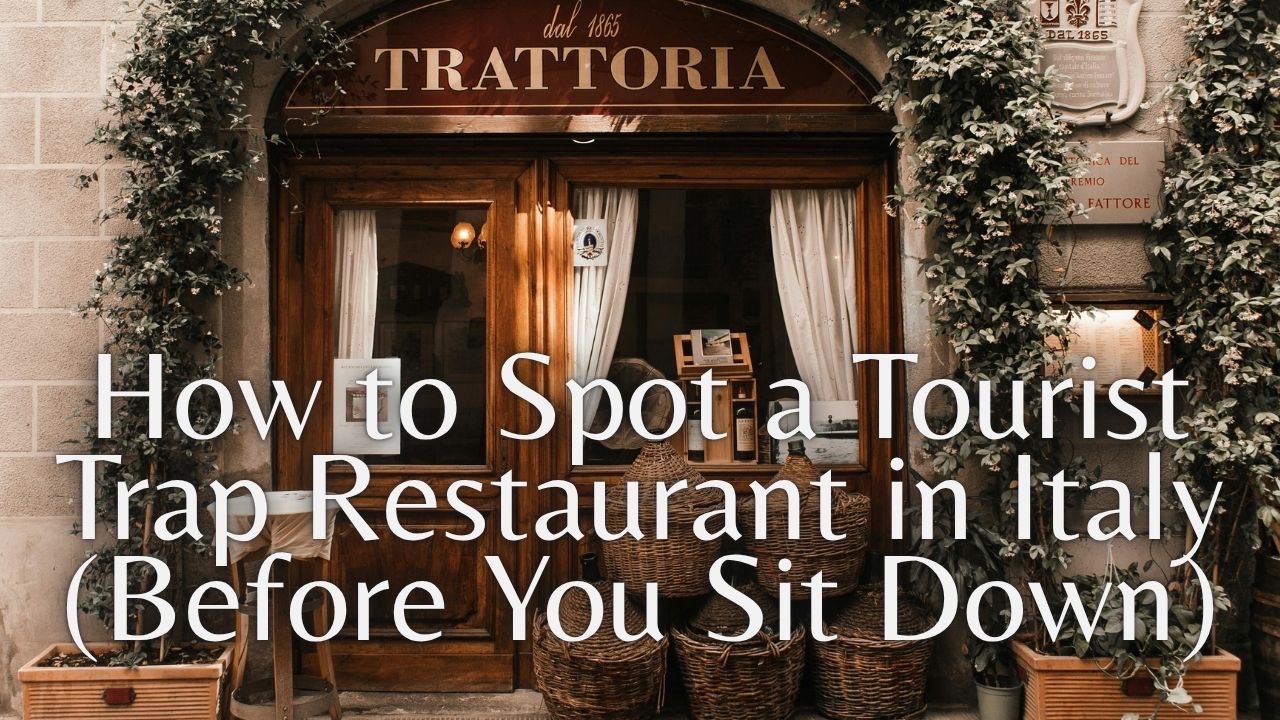
How to Spot a Tourist Trap Restaurant in Italy (Before You Sit Down)
You can usually spot a tourist trap restaurant in Italy in about five seconds, from the sidewalk, without reading a single dish. Look for five things: no prices posted outside, someone trying to pull you in, a table right on top of a major landmark, an enormous menu, and a menu printed in many languages. One of these on its own means very little. Two or more at the same door is your answer. Keep walking.
Here's how to read each sign, and what a good restaurant looks like instead.
Why this matters more in Italy
On most vacations, a bad meal is just annoying. In Italy, the food is half the reason you came. You only get so many lunches and dinners on one trip, and every one spent somewhere built for turnover is one you don't get back.
Sign 1: No prices posted outside
Look for a posted menu with a real price next to every dish. A pretty chalkboard with three dishes and no numbers doesn't count.
Restaurants that are comfortable with what they charge put it where you can see it. The ones that would rather you didn't compare are often charging more than the place next door for the exact same plate of cacio e pepe.
Sign 2: Someone trying to pull you in
If someone on the sidewalk is waving a menu at you, stepping into your path, or promising a table right now, notice it. A good, busy restaurant in Italy doesn't need to recruit people off the street. If a place has to stop you to fill its seats, the food probably isn't filling them.
Sign 3: You can touch the landmark
If your table is close enough to the Colosseum, the Trevi Fountain, or the Duomo that it shows up in your photos, you're paying for that view whether the menu says so or not. That rent shows up in your bill, and sometimes in the kitchen.
Not every restaurant near a landmark is bad. But "it's right here and I'm tired" is exactly what these places count on. Give it an extra thirty seconds of checking before you sit.
Sign 4: The menu is a novel
Count the dishes. A good family-run trattoria usually has fifteen, maybe twenty, and the menu changes with the season because someone is actually cooking them that day.
A laminated menu with a hundred and fifty or two hundred items, pizza, pasta, risotto, burgers, sometimes even sushi, isn't a kitchen making all of that fresh. It's a kitchen leaning on the freezer so it can say yes to everyone who walks in. The food isn't inedible. It just could be from anywhere.
Sign 5: Count the languages
Italian and English on a menu is completely normal anywhere tourists go. A menu with eight little flags across the top is a different business, built for volume and for people passing through once. Compare it to the place three streets over that only bothers with Italian, because Italians are who actually eat there.
Bonus: the ten-second phone check
While you're standing there, pull the restaurant up on Google Maps. You're not looking for perfect, you're looking for a pattern. Under four stars, very few reviews, or reviews that are all several years old tell you something the window display never will.
The two-sign rule
None of these signs is a dealbreaker by itself. Plenty of good restaurants sit near landmarks, and plenty have someone outside on a slow Tuesday. What you're watching for is two or more stacking up at the same door: no prices, a host on the sidewalk, steps from the Trevi, and a menu thicker than a phone book. That combination is your answer.
Signs you've found a good restaurant
- A handwritten specials board. Even a little chalkboard or a printed sheet clipped inside the menu usually means the kitchen is cooking what came in from the market that morning.
- A short menu. Eight or ten dishes is a great sign. It means someone can do every one of them well.
- Italians eating there. Walk by at one o'clock on a weekday. If it's full of people speaking Italian to each other and nobody is photographing their plate, you've found it.
Your quick sidewalk checklist
- Are prices posted?
- Is someone trying to pull you in?
- Are you sitting on top of a landmark?
- Is the menu enormous?
- How many languages?
Two or more, keep walking. Then look for the specials board, the short menu, and the Italians.
Once you've found the good restaurant, there's one line on the bill that confuses almost everyone: the couple of euros per person that looks like a scam and isn't. I explain it in my article on coperto and tipping in Italy. If you want help planning your whole trip, step by step, join the waitlist for my 21-day Italy trip planning program, or start with my Italy Travel Planning Guide.

